
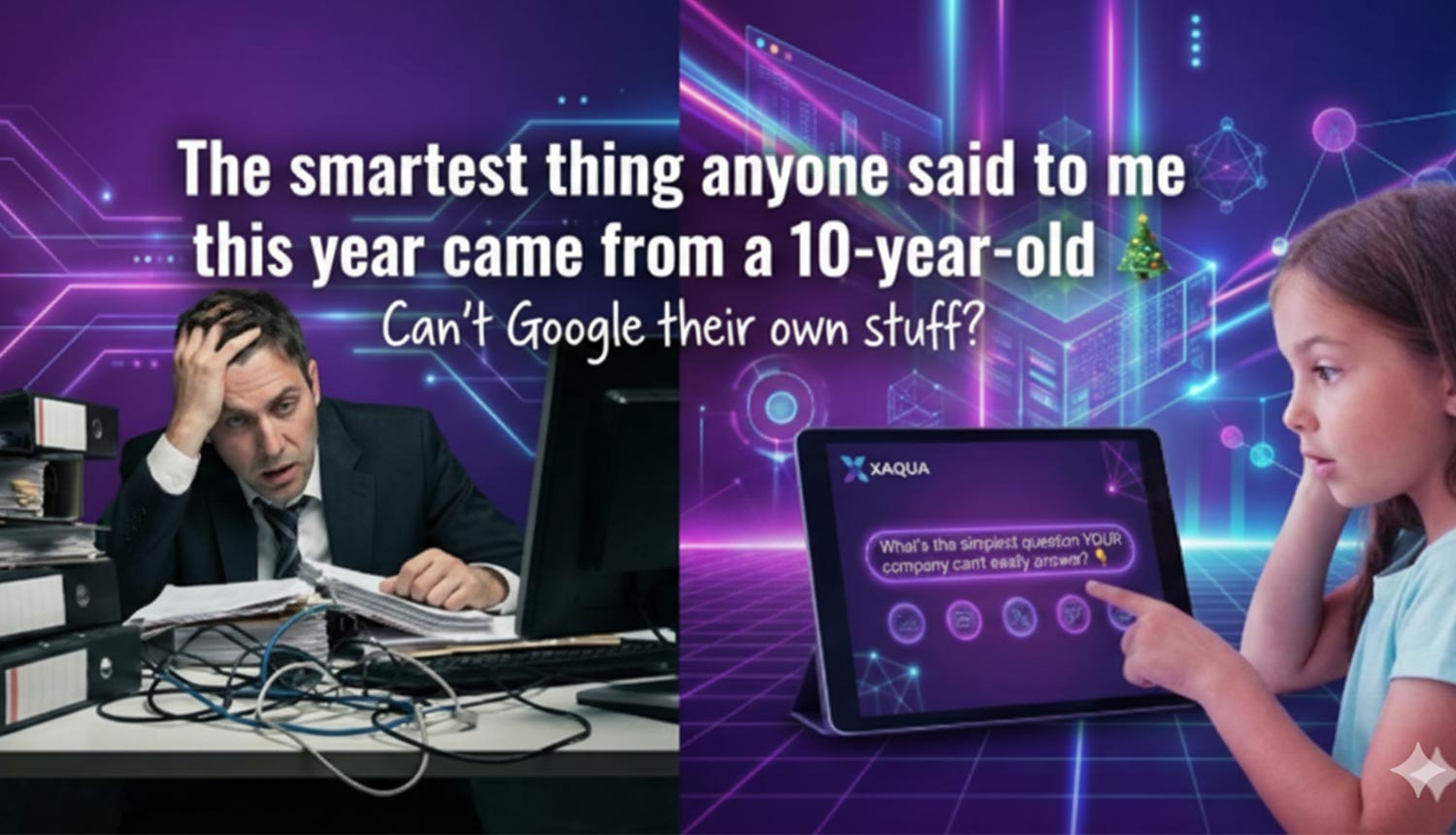
“So… you help them Google their own stuff?”
That question came from a 10-year-old who has never written a SQL query, doesn’t know what a data warehouse is, and has no idea what a semantic layer does.
But she understood something that our industry has been overcomplicating for 30 years.
Google searches the entire internet—billions of web pages, images, videos, and documents—in 0.2 seconds.
Yet most companies can’t search their own data in days. Sometimes months.
Think about that for a moment. You can ask Google anything about the world’s information and get an instant answer. But ask your own company “How many customers did we lose last month?” and suddenly it’s a project.
A question that should take 5 seconds takes 5 days.
Why? Because we’ve spent three decades building systems where companies CAN’T Google their own stuff. To answer even simple business questions, organizations need:
And after navigating all of that, you might get an answer in a week or two. If you’re lucky.
Here’s the uncomfortable truth: roughly 80% of business users in most organizations can’t access their own company’s data without help.
Not because they’re not smart enough. Not because they don’t have good questions. But because we’ve built systems that require technical fluency just to ask a question.
These are marketing leaders who want to understand campaign performance. Sales managers trying to forecast accurately. Operations teams looking for bottlenecks. Finance professionals reconciling numbers across systems.
They have the business context. They know what questions matter. They just can’t get answers without filing a ticket and waiting in a queue.
So what do they do? They stop asking. They make decisions based on gut instinct. They build shadow spreadsheets. They ping “the one person who knows” every time they need a number.
We’ve locked 80% of the organization out of data-driven decision making—and then wonder why analytics initiatives don’t deliver value.
Google solved information access at global scale with a remarkably simple interface: a search bar.
No query language required. No special training. No permissions workflow. Just type what you’re looking for in plain language, and get relevant results.
Behind that simple search bar is extraordinary complexity—crawlers, indexers, ranking algorithms, knowledge graphs, natural language processing. But you never see any of it. You don’t need to understand how it works to use it.
That’s the model. Complex machinery, invisible to the user. Simple interface, accessible to everyone.
Enterprise data should work the same way.
“But enterprise data is different,” the skeptics say. “It’s messy. It’s sensitive. It requires context.”
They’re not wrong. Enterprise data IS messy. Tables with names like TBL_CUST_2019_LEGACY. Columns labeled FLD_AMT_01 instead of “revenue.” Business logic locked in someone’s head—or worse, in a spreadsheet no one can find.
But here’s the thing: the internet was messy too. Billions of pages, different formats, no standards, contradictory information. Google didn’t solve information access by making the internet less messy. They built an intelligence layer that made sense of the mess for you.
That’s what enterprise data needs: not cleaner data (though that helps), but an intelligence layer that translates between human questions and machine data.
In the data world, we call this a semantic layer. It’s the translator that knows:
Without this translation layer, AI is just guessing. With it, a business user can ask a question in plain English and get an accurate, governed answer.
The technology to make “Google for your data” a reality exists today. Semantic layers. Natural language processing. Large language models. Governed access controls. It’s all here.
The real barrier? Organizational.
Data teams have built their value around being gatekeepers. Entire careers depend on being “the person who knows the data.” Letting business users self-serve feels like giving away power—or worse, inviting chaos.
But here’s the reframe: data teams shouldn’t be gatekeepers. They should be enablers. The goal isn’t to control who can access data—it’s to ensure that when anyone accesses data, they get accurate, governed, trustworthy answers.
The best data teams aren’t the ones fielding a hundred ad-hoc requests a week. They’re the ones who’ve built systems where those hundred requests never need to be filed in the first place.
The winning organizations in the next decade won’t just have better data.
They’ll have data anyone can access, understand, and act on—Anyone, Anytime, Anywhere.
Ask. Analyze. Act.
Ask a question in plain language. Analyze the results without waiting for a specialist. Act on the insight immediately.
No tickets. No queues. No translators. No two-week turnarounds for simple questions.
Just curiosity, rewarded.
Imagine a single search bar for your entire data platform. You don’t think about connectors, ETL, MDM, or BI tools. You just ask. And the system—built on a foundation of semantic intelligence, proper governance, and retrieval-first architecture—delivers accurate answers in seconds.
That’s not science fiction. That’s the standard we should be building toward.
A 10-year-old taught me more about the future of enterprise data in 30 seconds than most conferences do in 3 days.
She’s never heard of semantic layers, retrieval pipelines, or data governance frameworks. She doesn’t know what an LLM is or why context windows matter.
But she knows that when you want to find something, you search for it. Like she does with everything else in her world.
Maybe we should listen to the 10-year-olds more often.
They haven’t learned yet that simple things are supposed to be complicated.
Do you believe business users will ever truly Google their own data? Or will it always need translators?
The technology is ready. The question is whether organizations are willing to let go of the gatekeeping.
The future of data isn’t better tools for specialists. It’s the elimination of the need for specialists just to answer basic questions.
It’s data you can Google.
xAQUA is a Conversational Data Management platform where technical and business users collaborate with an AI Data Team—AI Data Analysts, AI Data Engineers, AI Data Scientists, AI BI Specialists, AI Data Governance, and AI Data Stewards—using natural language, no code required.
Built on a foundation of semantic intelligence and retrieval-first architecture, xAQUA makes enterprise data as searchable as Google—Anyone, Anytime, Anywhere.
Ask. Analyze. Act.
Learn more at xaqua.io